Ultragreen.AI: The Green Light

It has been almost a year since my last writeup of a Singaporean stock, as market reforms have resulted in positive revaluations across the exchange reducing the opportunity set. On the bright side, a very interesting new company took the opportunity to IPO on the SGX in December last year which I believe is underappreciated in its business quality and prospects. Ultragreen.AI ($ULG.si) is weirdly not an AI company, instead it is the world’s largest producer of Indocyanine Green (ICG), the fluorescent dye injected during surgery to illuminate blood flow, perfusion and tissue margins. The company has 70% market share in a growing market and is trading at just 16x forward earnings with an active buyback and insider purchases.
The Business
The first thing you need to understand about ICG is that there is zero patent moat here. ICG is a molecule that anybody can produce for incredibly cheap. However, this has been the case since 1976, yet in spite of the lack of patent protection the market has been run by only a few large players for the last two decades. The important thing to stress here is that Ultragreen has essentially built this market themselves. Before Ultragreen, ICG was a niche surgical chemical that was sold as a tiny part of broader pharmaceutical company offerings. Ultragreen drove the popularisation of Fluorescent Guided Surgery (FGS) through funding education and clinical studies. They were even responsible for founding and backing the International Society for Fluorescence Guided Surgery, a non-profit that aims to advance FGS adoption globally, along with collecting data and establishing guidelines. This isn’t based on nothing either, with the literature consistently being positive for the effectiveness of not just FGS generally, but specifically ICG against other forms of surgical dyes.
This has been a remarkably effective strategy that allowed the company to build a dominant global position especially in their main market of Europe, where they have 95% market share. In the US they operated as a secondary player to pharmaceutical distributor Akorn before buying their NDA ICG and business out of bankruptcy in 2023, taking them to a dominant 83% market share. Most of the remaining market share is taken up by Stryker, a medical devices company who bundles it with their medical imaging hardware and software. Notably Stryker doesn’t sell to customers who don’t use their hardware, which means they aren’t really in competition with Ultragreen. The only other notable markets are Japan and China, which are both dominated by local companies Daiichi Sankyo and Dandong respectively. While their Asian expansion is limited by their inability to penetrate these two key markets, I believe that their existence actually adds to the bull case here as it demonstrates the dominant local moats that these companies are able to build.
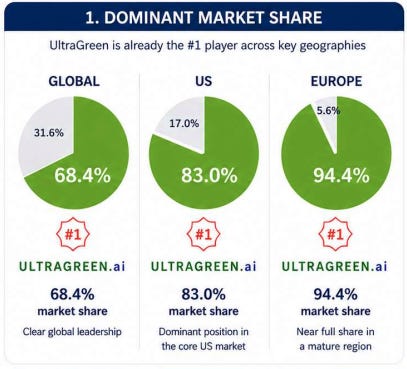
So where does this moat come from? ICG currently is a relatively small market globally. As stated earlier Ultragreen has 70% market share and still only made $137m in revenues last year. In contrast to this, the cost to try and penetrate one of these markets is surprisingly high. For a given market a competitor would need to invest in regulatory permissions, specialised manufacturing, along with building out a dedicated sales force to deal with the notorious inertia of hospital procurement, all over the timeframe of minimum 3-5 years. Lets say you are competing for the $100m of revenue in the US market, undercutting on price by 30% ($70m) and you are able to take 20% of market share you’re looking at $14m of annual revenues along with the impending risk that Ultragreen decide to compete on price and crush you. And this is just in the US, the fragmented regulatory markets of Europe and Asia make them even less economical. Ultragreen spent years establishing the demand, relationships, infrastructure and regulatory approvals and are now reaping the reward as the incumbent.
Growth
The potential growth is where this gets interesting, as Ultragreen has potential to win on both price and volume. For price, the company’s pricing power differs for different markets. Within Europe it’s somewhat limited due to national health system procurement processes such as with the NHS in the UK. As these systems operate with centralised price negotiation and pricing frameworks their ability to raise prices significantly above inflation is limited as there are always still other options such as Japan’s Daiichi Sankyo. In contrast the company has been aggressively flexing their pricing power in the US since the Akorn bankruptcy, raising the price of vials (which had to be fair been underpriced by Akorn prior) by 60% in 2023, 30% in 2024 and 22% in 2025, with no further price increases planned. While these price increases may seem high, it’s important to note that prices are $181 a vial, charged to the customer and often insurance, as part of procedures that can cost thousands to tens of thousand of dollars and can be the difference between a successful and unsuccessful surgery. It’s a classic low cost segment of a large cost product with a high cost of failure that investors love to see. These price increases haven’t passed through to all hospitals however with hospitals under Group Purchasing Organisations (GPOs) still being sold at historically contracted prices. This follows a similar track to Europe where organisations with negotiating power are able to limit the ICG price increases, while independent hospitals have just had to eat it. Guidance assumes flat pricing for the GPO hospitals which is probably most likely, but there is the possibility that on the next renewal Ultragreen would be able to pass some of those price increases through to the GPO hospitals.
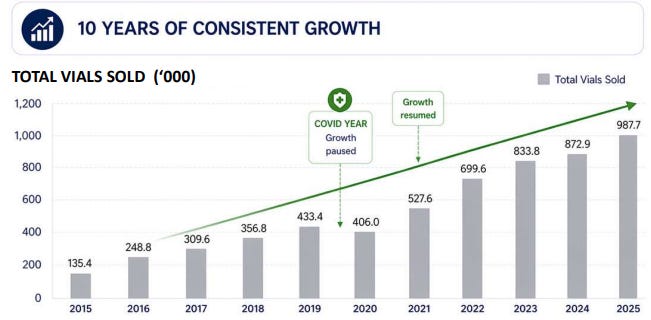
Volumes are where I believe this story is most interesting. Ultragreen’s historic growth has been fantastic with a 10 year volume CAGR of 22% to 2025. In spite of this, FGS adoption is still surprisingly low, especially in their largest market America. Specific data here is limited, but management has put forward a target market of 10m addressable procedures in the US annually versus 670’000 vials sold there last year. While this sounds ambitious, it isn’t ridiculous when observing penetration in the more mature European market. A survey conducted in 2020 amongst 44 centres dealing with colorectal disease in Italy found 72% of surgeons were using ICG in every procedure, and penetration has likely increased since then. This dynamic is backed up by an international study of colorectal surgeons in 2024 which found that 67% of surgeons who had access to ICG would use it when available, though it was only available at 76% of institutions. The path forward is to continue to penetrate global (and particularly the US) surgical markets by increasing institutional access, along with driving the education for surgeons to use it. The effectiveness of this in the US is being shown in vial volumes, but also in the sales of Da Vinci consoles (which are the hardware used for these procedures). Where 42% of Da Vinci sales shipped with the ‘Firefly’ module (a module that requires the use of ICG for fluorescent imaging) in 2023, that number is now up to over 60% in 2025, demonstrating the increasing demand for this process.
Financials
Getting into the financials we can see that this is a fantastic business. On a market cap of $1.3B USD the company did $62m of underlying earnings last year against $138m of revenue for 45% net profit margins. Gross margins and ROIC are strong as well at 85% and 28% respectively. Forward guidance is for revenue in the range of $170-190m which would imply 30% revenue growth at the midpoint and would see earnings of $81m (assuming no margin expansion) for a forward multiple of 16. Additionally to this, the company has $176m net cash on the balance sheet, which if taken out gets them to a cash adjusted PE closer to 14. Obviously there is competition and capital allocation risk here, but if the business trajectory continues as is I believe that this is too cheap. The company has historically paid a dividend, but post IPO has cut the dividend in preference of reinvesting in the core business, acquisitions (which they have a reasonable track record in), and an opportunistic buyback (which has seen use but not in a significant way so far).
I think management here is of reasonable quality. CEO Ravinder Sajwan doesn’t have a medical background, but does have an entrepreneurial background and did a fantastic job at recognising and consolidating a fragmented market in ICG. His family is heavily invested in the company through the majority holding Renew Group, though they did take some money off the table in the IPO. I’d consider this an amber flag, especially considering they still have maintained a large holding post IPO. What is more promising is that multiple directors including Ravinder himself have been buying shares on market with this recent selloff. I management has a solid track record of acquisitions, operations and general decision making with no raging red flags. The only other concern I would highlight is the naming of the company. In the lead up to the IPO the company changed its name from Diagnostic Green to Ultragreen.ai despite the “ai” aspect of the business being tiny. I am always skeptical of overly promotional management, but I haven’t seen much else from the company to warrant concern.
Risks
The core risk here comes down to competition. As stated earlier, the company has no real defence against a generic version of the drug coming to market other than procurement inertia and the costs involved with competing. I think that they do need to be careful on how much price they take in the US, as the more they jack up prices, the more incentive there is for a competitor to come to market with a generic. Similarly, a core defence has been the small size of the ICG market, which has made competing for it uninteresting to competitors. As the company and market continues to grow, the size of the market may hit a point where it gets more interesting for competitors to explore competing. These are all completely real risks that stop me from sizing up too aggressively here. However, I do believe that the more likely scenario is a continuance of the status quo.
Another thing to note is supply chain concentration. Historically the company has only had one supplier and in 2024 they had to deal with a multiple month shortage of ICG because there was a disruption at their manufacturer. While they are currently working on diversifying their supply chain and adding more suppliers, this concentration does make them vulnerable in the near future.
Conclusion
Ultragreen is a rare example of a generic product producing monopoly-like economics. The company has a moat built upon the regulatory approvals, validated supply chain, distribution network and clinical adoption that it has accumulated over two decades. These advantages have produced dominant market shares, exceptional margins and a credible runway from the continued adoption of fluorescence-guided surgery. At roughly 14 times earnings adjusted for cash, the valuation appears attractive for a business of this quality. The central risk is that continued market growth and aggressive US pricing eventually make entry worthwhile for competitors. I would not treat Ultragreen as an untouchable monopoly, however I do believe that the likely base case is that their moat continues to hold, providing an attractive risk-reward at the current price. I hold a small 2% position at the time of writing.
great write up. thanks
Another company has received the USFDA approval for the generic version of IC-Green. on 4th August 2026.
Negative for margins and for the stock.